Problem 01
Store operations live across disconnected tools
Checkout, loyalty, stock, receipts and campaign activity often sit in separate systems, limiting visibility and increasing manual work.
Higher operating frictionShopper's Mate is designed to connect retailer checkout, the Reward's Mate customer experience, digital receipts, basic inventory visibility and retailer reporting in one workflow. Marketplace discovery and community polling surfaces are currently product prototypes.
Pre-pilot. MVP in development. No live-store traction or validated performance metrics yet. All figures and scenarios on this page are indicative and subject to pilot validation.
Confidential investor briefing. Commercial assumptions are indicative and subject to pilot validation. Marketplace and community polling experiences are currently product prototypes.
Prototype product surfaces
Shopper's MateRetailer dashboard
Illustrative preview
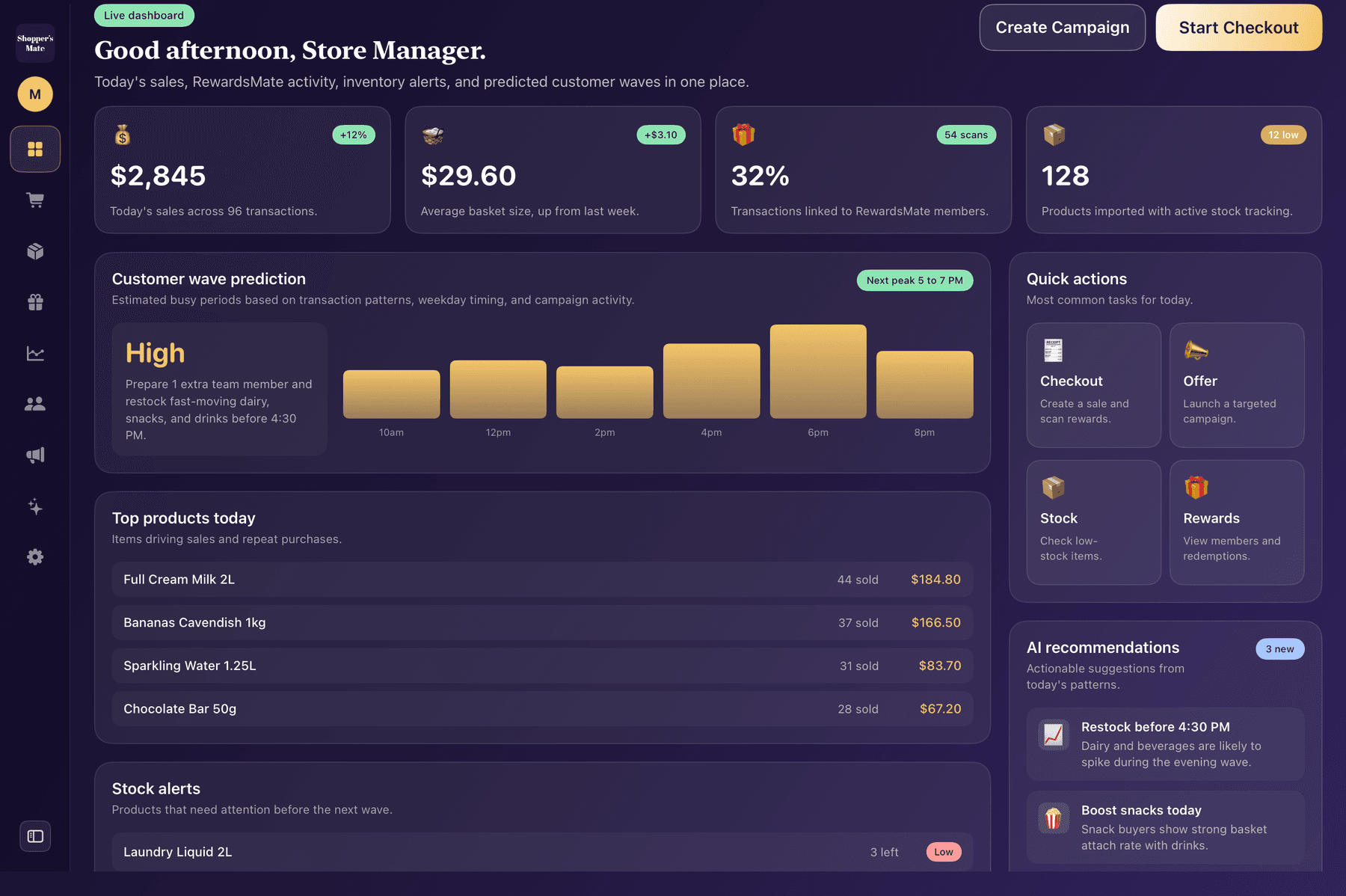
Checkout, sales, stock signals and customer activity in one retailer view.
Investor snapshot
Skim the essentials first, then use Deep Dive for detailed assumptions.
Stage
MVP development
Core POS, loyalty and retailer workflows are in build. Reward's Mate marketplace, catalogue and polling experiences are represented through prototypes.
Beachhead
One Brisbane catchment
Begin with 5 to 8 retailers within a single Brisbane catchment to test retailer supply, customer discovery and repeat engagement. Density within one catchment is more valuable than a scattered store count because nearby participating retailers can create a more useful customer network, clearer cross-retailer discovery behaviour and stronger local feedback loops.
Model
Subscription plus net eligible sales platform and rewards fee
Retailers pay $350 per store, per month, plus 1.25% of net eligible sales excluding GST. The base Reward's Mate customer experience remains free.
Marketplace type
Local discovery
Customers discover participating stores, sale products, offers and community polls. Online ordering and delivery are not part of the initial proposition.
Pilot validation
Supply + demand
Measure retailer publishing, customer discovery, poll participation, QR activity, redemptions and repeat engagement.
Moat logic
Workflow + marketplace + data
Store operations, customer identity, listings, offers, votes and transaction outcomes create a connected learning loop.
Smaller retailers often manage checkout, loyalty, stock and promotions across disconnected tools. At the same time, their products and offers can be difficult for nearby customers to discover, while short-run product decisions are frequently made without a direct signal from the people most likely to buy.
Today's independent retail stack
Checkout, loyalty, stock, receipts and campaign activity often sit in separate systems, limiting visibility and increasing manual work.
Higher operating frictionIndependent retailers may have strong products and timely offers but lack a connected customer channel for presenting them to nearby shoppers.
Missed local demandSeasonal products, promotional ranges and limited-time items may be ordered before retailers have a clear indication of customer interest.
Overstock or missed salesMost systems record the transaction but do not create an ongoing loop for discovery, participation, rewards and future visits.
Weak repeat engagementThe result
Shopper's Mate manages retailer operations and marketplace publishing. Reward's Mate gives customers one place to discover local stores, products, offers and rewards, while participating in retailer-created polls. The intelligence layer connects these interactions with sales, loyalty and inventory signals over time.
Retailer operating and publishing layer
POS checkout, product catalogue, inventory activity, sales reporting, offer publishing, community poll creation and staff workflows.
Investor takeaway
Shopper's Mate is not selling a cheaper till. It is building the system independent retailers use to run the store, reach nearby customers, test demand before buying stock, and turn everyday activity into better decisions.
Shopper's Mate gives retailers a direct path from publishing an opportunity to learning how customers respond.
01
A retailer publishes a product, sale or short-run promotion.
Retailer action
02
It appears in Reward's Mate with clear store, product and timing details.
Customer discovery
03
Customers browse the offer or vote in a retailer-created product poll.
Customer response
04
The retailer uses the response to plan stock, promotions or a customer campaign.
Retailer decision
05
Engagement, redemption and sales outcomes inform the next decision.
Learning signal
Reward's Mate currently demonstrates local store discovery, sale products and customer voting through prototype experiences, so investors can see how demand signals form before a full pilot network is live.
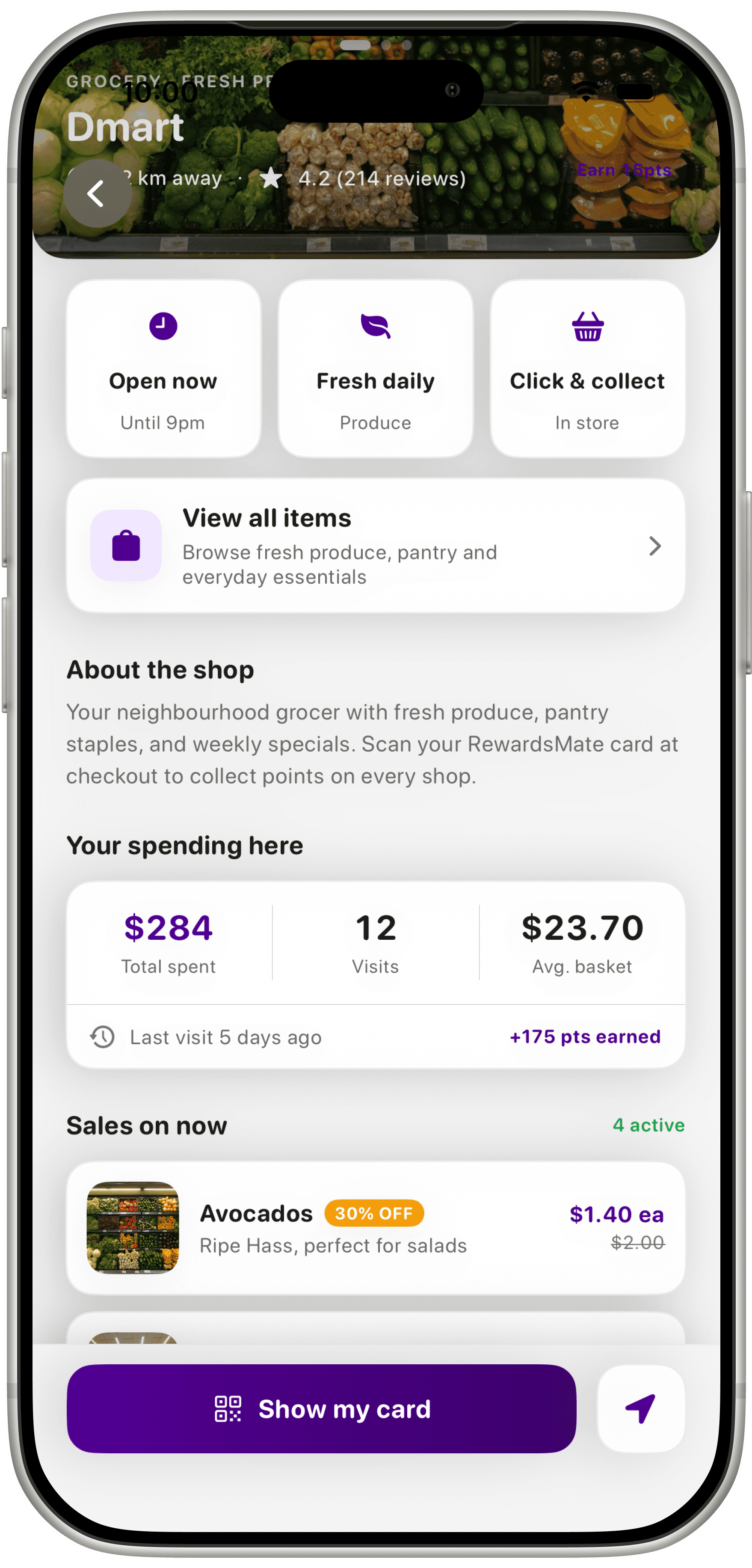
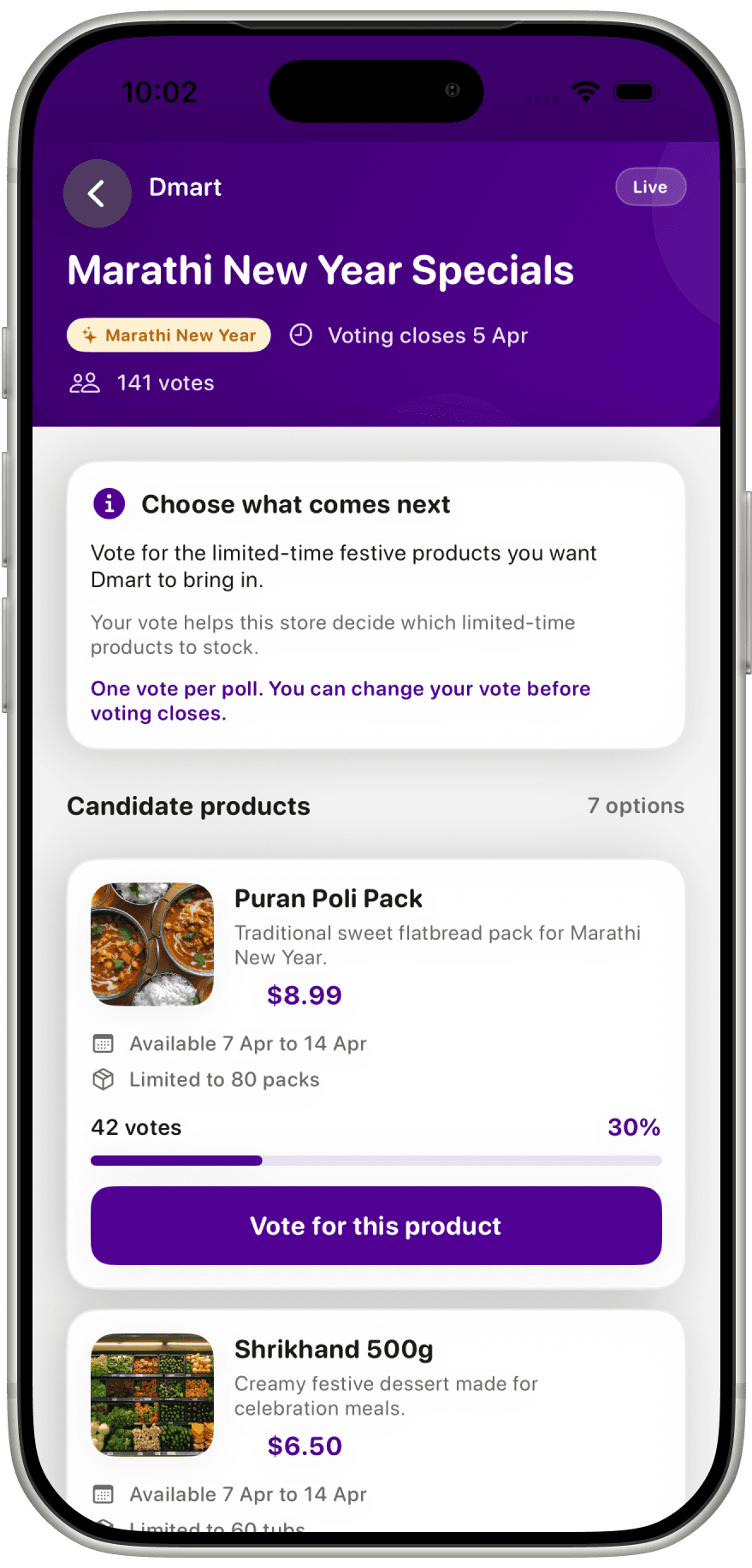
Investor takeaway
Reward's Mate is the customer discovery and participation layer connected directly to the retailer operating system.
That connection turns retailer activity and customer response into measurable signals rather than isolated marketplace engagement.
Shopper's Mate works across the retailer dashboard, checkout workflow, local marketplace discovery and community participation in Reward's Mate.
Retailer Dashboard
The retailer operating view for daily sales, publishing and engagement, designed so store teams can act from one place rather than juggling separate tools.
What this surface includes
Sales and customer activity
Product and offer publishing
Poll creation and status
Listing and poll engagement
Campaign and stock signals
Why it matters
Australia has a large base of small businesses and a strong independent retail sector. Shopper's Mate is starting with a focused wedge: cafés, restaurants, grocery stores, convenience stores, and specialty retailers.
2.73M
Actively trading businesses in Australia at 30 June 2025.
97.3%
Of Australian businesses are small businesses by employment size.
86%+
Australian consumers are members of at least one loyalty program.
Sources: ABS, ASBFEO, Australian Loyalty Association, ResearchAndMarkets.
Our initial serviceable market is not every Australian business. The first wedge is hospitality and local retail, where repeat visits, basket size, stock movement, and customer loyalty have direct commercial impact.
Retailers become marketplace supply
Every participating retailer can contribute stores, products, offers and community polls.
Customers gain more reasons to return
Reward's Mate becomes useful for discovery and local participation, not only checking a points balance.
Engagement can become demand intelligence
Product views, offer activity, votes and eventual transaction outcomes can provide stronger signals for promotional and stock decisions.
The platform can expand by local density
Building a useful network within individual suburbs or retail clusters creates a more practical launch path than attempting broad national coverage immediately.
Internal planning note
Our initial serviceable market is focused, not the whole Australian business base. The goal is to prove ROI in high-frequency retail categories first, then expand only after onboarding and retention are working.
The initial model remains retailer-funded subscription software. Marketplace monetisation should only be introduced after the pilot demonstrates useful customer demand and measurable retailer value.
Retailers pay $350 per store, per month for Shopper's Mate POS, Reward's Mate loyalty, dashboards, reporting and marketplace access.
1.25% of net eligible sales excluding GST recorded through Shopper's Mate, including sales with no Reward's Mate scan. Customers earn 1% on eligible identified purchases.
Future marketplace revenue options are planning assumptions only. Shopper's Mate is not currently presenting online ordering, delivery or transaction commissions as part of the model. Commercial assumptions are indicative and subject to pilot validation.
Investor takeaway
Retailers pay a monthly platform subscription plus a net eligible sales platform and rewards fee on net eligible sales excluding GST recorded through Shopper's Mate.
Not validated by live-store performance. MVP in development. Initial Brisbane pilot planned. No live retailers, no live customers and no confirmed unit economics yet.
$350 per store, per month
One Shopper's Mate subscription includes POS, Reward's Mate loyalty, basic reporting and marketplace access.
The 1.25% is based on net eligible sales excluding GST, whether or not a Reward's Mate member scans. A customer scan determines reward eligibility, not whether the retailer fee applies.
Retailers pay $350 per store, per month, plus 1.25% of net eligible sales excluding GST.
The 1.25% is based on net eligible sales excluding GST, whether or not a Reward's Mate member scans. A customer scan determines reward eligibility, not whether the retailer fee applies. Customers earn 1% of eligible identified purchases.
Included with the platform plan. There is no separate public setup fee.
Shopper's Mate intends to maintain liquid reserves equal to at least 30% of outstanding redeemable points liability, subject to higher requirements based on expected redemption activity, unsettled retailer payments, fraud exposure and operational risk.
The appropriate reserve level and accounting treatment will be validated through pilot data and professional accounting advice. This is a stated intent, not a guarantee of solvency or of the ability to fund every redemption request.
Investor takeaway
Switch to Deep Dive to view indicative internal planning scenarios and assumptions. Figures are modelled planning only, not current traction.
Shopper's Mate will begin with a concentrated Brisbane retail cluster, seed useful marketplace content, acquire customers in-store through Reward's Mate, then expand only after the complete loop shows directional value.
Brisbane independent retailers where founder-led sales, hands-on onboarding, and direct feedback loops are practical.
Local pilotMeasure marketplace engagement, poll participation, QR scans, rewards activity, repeat visits and retailer publishing behaviour.
ROI evidenceUse retailer results, customer activity and repeatable onboarding to add adjacent retailers and suburbs.
Density firstPhase 01
Goal
Onboard 5 to 8 retailers within a single Brisbane catchment.
Success signal
Retailers agree to pilot and publish useful marketplace content
Phase 02
Goal
Publish accurate store profiles, sale products, current offers and at least one relevant poll per participating retailer.
Success signal
Each retailer has fresh listings and at least one active poll
Phase 03
Goal
Use checkout QR prompts, receipts, retailer-owned social channels and in-store signage to introduce Reward's Mate.
Success signal
Customers register and begin discovering local listings
Phase 04
Goal
Track marketplace engagement, poll participation, QR scans, rewards activity, repeat visits and retailer publishing behaviour.
Success signal
Directional evidence appears across supply, demand and repeat engagement
Phase 05
Goal
Use retailer results, customer activity and repeatable onboarding to add adjacent retailers and suburbs.
Success signal
Repeatable onboarding and adjacent-suburb expansion path
Investor takeaway
POS is the workflow. Reward's Mate is the discovery and participation layer. Connected first-party signals are the long-term advantage.
Operational flywheel
01
Checkout
Shopper's Mate sits inside the daily transaction flow.
02
Customer identity
Reward's Mate links sales to customer behaviour.
03
Transaction and stock data
Everyday activity becomes structured operational signal.
04
Better decisions
Retailers can act on clearer stock, offer and customer prompts.
05
Greater retailer value
Useful decisions increase retention and workflow dependence.
06
Stronger workflow retention
Embedded operations make switching more costly over time.
Marketplace flywheel
01
Retailer listings and polls
Participating stores publish products, offers and demand tests.
02
Customer discovery and participation
Nearby shoppers browse, engage and vote in Reward's Mate.
03
Demand signals
Views, opens and votes create directional local demand evidence.
04
Better products and promotions
Retailers can plan ranges and campaigns with clearer response.
05
More useful marketplace
Fresher listings and relevant polls make the app worth opening.
06
More customers and retailers
Useful density attracts more local participation on both sides.
Shopper's Mate sits inside the daily transaction workflow, making it more embedded than a standalone analytics, marketing or marketplace tool.
High workflow stickinessRetailers build direct customer relationships through loyalty activity, purchase history, offers, receipts, listing engagement and poll participation.
Data advantageThe marketplace makes the network concrete: more retailers means more listings, offers and polls worth opening the app for; more customers means more demand data worth listing for.
Network effects over timeTransaction, loyalty, listing, campaign and polling signals can support clearer stock, promotion and customer decisions as real data matures.
Compounding intelligenceBuilt for Australian independent retailers first, with local workflows, concentrated beachhead density, support expectations and retailer realities in mind.
Local execution advantageInvestor takeaway
Shopper's Mate is being designed to progress from transaction reporting into predictive retail intelligence. The first stage is building the data foundation through POS transactions, loyalty activity, campaigns, customer visits, store operations and inventory movement.
Once sufficient pilot data is available, we plan to begin a dedicated research and development phase focused on customer-wave forecasting and total store revenue prediction.
The objective is to give Australian retailers practical forecasting support for staffing, stock preparation, budgeting, campaign planning and day-to-day operational decisions.
Model Area 01
Planned Forecasting ModelCustomer-wave prediction will estimate when a store is likely to experience higher or lower levels of customer activity.
The purpose is to help retailers prepare for busy and quiet trading periods, plan staffing, improve stock availability and respond to expected changes in customer traffic.
The forecast will focus on expected customer activity across selected hours, days or future trading periods. It will be developed as a decision-support tool rather than a guaranteed prediction.
Early research will evaluate time-series forecasting and regression-based approaches.
These models will create transparent forecasting baselines before more specialised methods are developed, tested and validated.
The research team will compare statistical forecasting methods, seasonal baselines and machine-learning regression models using time-based retail features.
Instead of displaying only a prediction, Shopper's Mate will explain the factors influencing it. A retailer may see that a predicted busy period is influenced by recurring Friday trade, an upcoming public holiday, an active promotion, weather conditions or comparable historical periods.
Model Area 02
Planned Forecasting ModelWithin Shopper's Mate, sales prediction refers specifically to forecasting total store revenue.
The planned model will estimate expected store revenue across selected future trading periods.
The forecast will be designed to support budgeting, staffing, operational preparation and campaign planning. It will be presented as decision support and not as a guaranteed financial outcome.
Revenue forecasts will be estimates based on historical and contextual data. They will not represent guaranteed financial outcomes.
Model development will begin after sufficient pilot data has been collected, reviewed and validated during the research and development phase.
Shopper's Mate does not intend to rely only on generic forecasting models trained on overseas retail behaviour.
Australian customer behaviour is influenced by local seasons, climate, public holidays, school calendars, geography, community events, regional shopping patterns and category-specific trading conditions.
A retail model developed using overseas data may provide useful starting techniques, but it should not be assumed to transfer reliably to Australian retailers without local data, testing and calibration.
Through research and development, Shopper's Mate plans to curate forecasting models using Australian retail data collected through the Shopper's Mate ecosystem.
The objective is to test whether Australian retail data and locally relevant behavioural signals can produce more useful, explainable and commercially relevant forecasts for Australian businesses.
Shopper's Mate also plans to explore partnerships with Australian companies, research organisations and technology teams interested in building sovereign AI capabilities for Australian businesses.
These partnerships are part of the planned research direction. No formal partnership should be implied unless one has been signed and approved for public communication.
The objective is not to create an Australian model for branding purposes. The objective is to develop and validate forecasting systems that reflect how Australian retailers and customers actually behave.
Shopper's Mate plans to use a layered forecasting architecture.
The platform will begin with a common Australian retail base model. It will then add category-specific features and progressively calibrate forecasts using each store's own data.
Stage 01
Learns broad temporal, seasonal and behavioural patterns across participating Australian businesses.
The base model is intended to provide initial forecasting support when a new retailer does not yet have enough store-specific history.
Stage 02
Adds features relevant to the retailer's operating model and business category.
Different businesses experience different customer waves, seasonal patterns, operating constraints and revenue drivers.
Stage 03
Progressively adapts the forecast using the individual store's own history, location, campaigns, customer activity, opening hours and operational conditions.
A restaurant model may require features related to meal periods, bookings, takeaway demand, delivery activity and local events.
A grocery model may place greater emphasis on weekly shopping patterns, public holidays, promotions, stock availability and household purchasing cycles.
A salon or service-business model may require appointment patterns, service duration, booking lead time, repeat-customer cycles and staff availability.
This layered approach is intended to provide useful initial forecasts for newer retailers while allowing predictions to become increasingly store-specific as more local data becomes available.
24 months
Planned target of high-quality historical data for a fully calibrated store-specific forecasting model.
For a fully calibrated store-specific forecasting model, Shopper's Mate plans to use at least 24 months of high-quality historical data.
Two years of data should provide coverage across multiple seasonal cycles and allow the model to observe changes in customer activity and revenue during major annual events.
The 24-month target applies to mature store-specific forecasting. It is not a requirement for a retailer to join Shopper's Mate.
A new retailer may begin with the Australian retail base model and an appropriate category-specific model while its store-level history develops.
The R&D phase will evaluate whether some business categories require more or less historical data and whether forecast quality can be improved using comparable-store information.
Shopper's Mate plans to conduct a scheduled full model retraining every quarter.
Quarterly retraining is intended to capture seasonal transitions, festive periods, public holidays, changes in promotion effectiveness, new store data and evolving customer behaviour.
A quarterly cycle provides enough time for meaningful new patterns to emerge while avoiding unnecessary model changes based on short-term noise.
Review forecast performance, unusual errors and significant differences between expected and actual outcomes.
Review incoming data quality, behavioural changes, store-level performance and signs that the current model is becoming less reliable.
Retrain the base, category and relevant store-calibration layers using newly available and validated data.
Recalibrate or retrain a model when a material operational or behavioural change makes the existing model less representative.
The final retraining schedule may vary by model type, store category and data volume. The R&D phase will validate the most appropriate operating frequency.
Retail behaviour changes over time. A model that performed well during one period may become less reliable when customer behaviour, store operations, local conditions or seasonal patterns change.
Shopper's Mate plans to monitor both data drift and performance drift.
Data drift occurs when the characteristics of incoming data change.
Performance drift occurs when forecast accuracy declines, even when the incoming data initially appears valid.
The precise drift thresholds, review periods and automated retraining triggers will be determined and validated during the research and development phase.
Forecasts should never be presented as guaranteed point estimates.
Retailers should see both the expected outcome and the level of uncertainty surrounding it.
When confidence is low, Shopper's Mate should avoid presenting a strong operational instruction.
The platform should provide a conservative recommendation, explain the source of uncertainty or advise the retailer to review the situation manually.
Instead of saying 'Add two staff members tomorrow,' the platform may say:
“Customer activity may be higher than usual tomorrow afternoon, but confidence is limited because this event has not occurred in your store history. Review staffing and stock preparation before making a final decision.”
Explainability is a product requirement from the beginning of the forecasting program.
Retailers should not receive unexplained AI instructions.
Every recommendation should help the retailer understand what the platform expects, why it expects it and what action may be considered.
Required explanation structure
What Shopper's Mate expects to happen.
The main factors influencing the prediction.
How confident the system is and what is affecting that confidence.
What the retailer may consider doing.
When the action may be relevant.
When the underlying data and model were last updated.
Instead of displaying only:
“Prepare for a busy period.”
Shopper's Mate should explain:
“Customer activity is expected to be higher than normal between 4 pm and 7 pm. This forecast is influenced by recurring Friday trade, an upcoming public holiday, the current promotion and comparable historical periods. Consider reviewing staffing and stock levels before the afternoon trading period.”
Recommendations, retailer actions and actual outcomes should be recorded where appropriate. This will help the team assess whether recommendations are useful and improve future decision support.
Forecasting models will be evaluated using time-based testing that reflects how they would operate in a live retail environment.
Random train-test splitting should not be used as the primary validation method for time-dependent retail forecasts because it can allow future information to influence model evaluation.
Validation Method 01
Train the model using only data available before a selected forecast date.
Forecast the next period, compare the result with the actual outcome and repeatedly move the forecast date forward.
This simulates how the model would have performed across multiple historical trading periods.
Validation Method 02
Hold out complete seasonal periods to test whether the model generalises across summer, winter, school terms, holidays and recurring annual changes.
The model should not be evaluated only during normal or stable trading periods.
Validation Method 03
Evaluate model performance separately during unusual or commercially important periods.
Validation Method 04
Measure forecasting performance across different stores, business categories, forecast horizons and trading conditions.
A model that performs well for grocery retail may not perform equally well for restaurants, salons or speciality retail.
Every candidate forecasting model should be compared against transparent and understandable baseline methods.
A complex model should only progress when it consistently improves on an appropriate baseline and does not introduce unacceptable forecast bias.
If a simpler baseline is more reliable than the advanced model for a specific store or period, the platform should use or display the simpler forecast.
The final performance thresholds required for production deployment will be established during research and development.
Shopper's Mate plans to develop its forecasting advantage through proprietary, consent-based data collection, behavioural signal design and structured survey methods.
The purpose is to collect retail context that may not be represented adequately in generic overseas datasets.
Retailer surveys may help identify operational factors that are not visible in transaction data, including staffing constraints, local events, temporary closures, product availability and changes in store strategy.
Customer surveys may help the team understand shopping motivations, visit timing, promotion sensitivity and local preferences, subject to consent and privacy requirements.
These methods will be developed and tested during the research and development phase.
The long-term advantage is not expected to come from ownership of one forecasting algorithm.
Forecasting methods can often be reproduced. The more defensible opportunity is the combination of Australian transaction data, loyalty activity, campaign responses, customer visit patterns, store context, survey research and continuously evaluated forecasting models within one retail operating system.
As participating retailers generate more consented and securely managed data, Shopper's Mate may be able to improve forecasting quality across different business categories while maintaining store-level relevance.
The potential advantage will come from:
This creates the potential for an Australian retail intelligence layer that generic POS systems, standalone loyalty apps and general international models may find difficult to reproduce.
These forecasting capabilities are currently part of the planned intelligence roadmap. They are not yet operational production models.
Shopper's Mate is currently founder-led and is preparing for the pilot, data-collection and research stages.
The founder is actively seeking the technical, data, product and research team required to develop, test and validate the forecasting program.
The research and development phase will establish the final modelling architecture, feature engineering, data thresholds, performance requirements, drift rules, uncertainty framework and production deployment approach.
Forecasting development will follow data-minimisation, consent, transparency, security and privacy-by-design principles.
Wherever possible, operational forecasts should use aggregated behavioural signals rather than expose identifiable customer information.
Customer information must not be sold or exposed through retailer forecasting outputs. Retailers should receive operational insights, not access to unnecessary personal customer data.
Read more about our approach in the privacy policy and security overview.
Retailers must remain responsible for final staffing, stock, pricing and campaign decisions. Shopper's Mate forecasts should support human decision-making rather than remove retailer control.
Shopper's Mate is in MVP development. Reward's Mate marketplace, catalogue and polling experiences currently exist as prototypes, while shared production publishing and analytics remain planned.

The MVP foundations are being built around checkout, loyalty, receipts, retailer workflows and marketplace publishing paths.
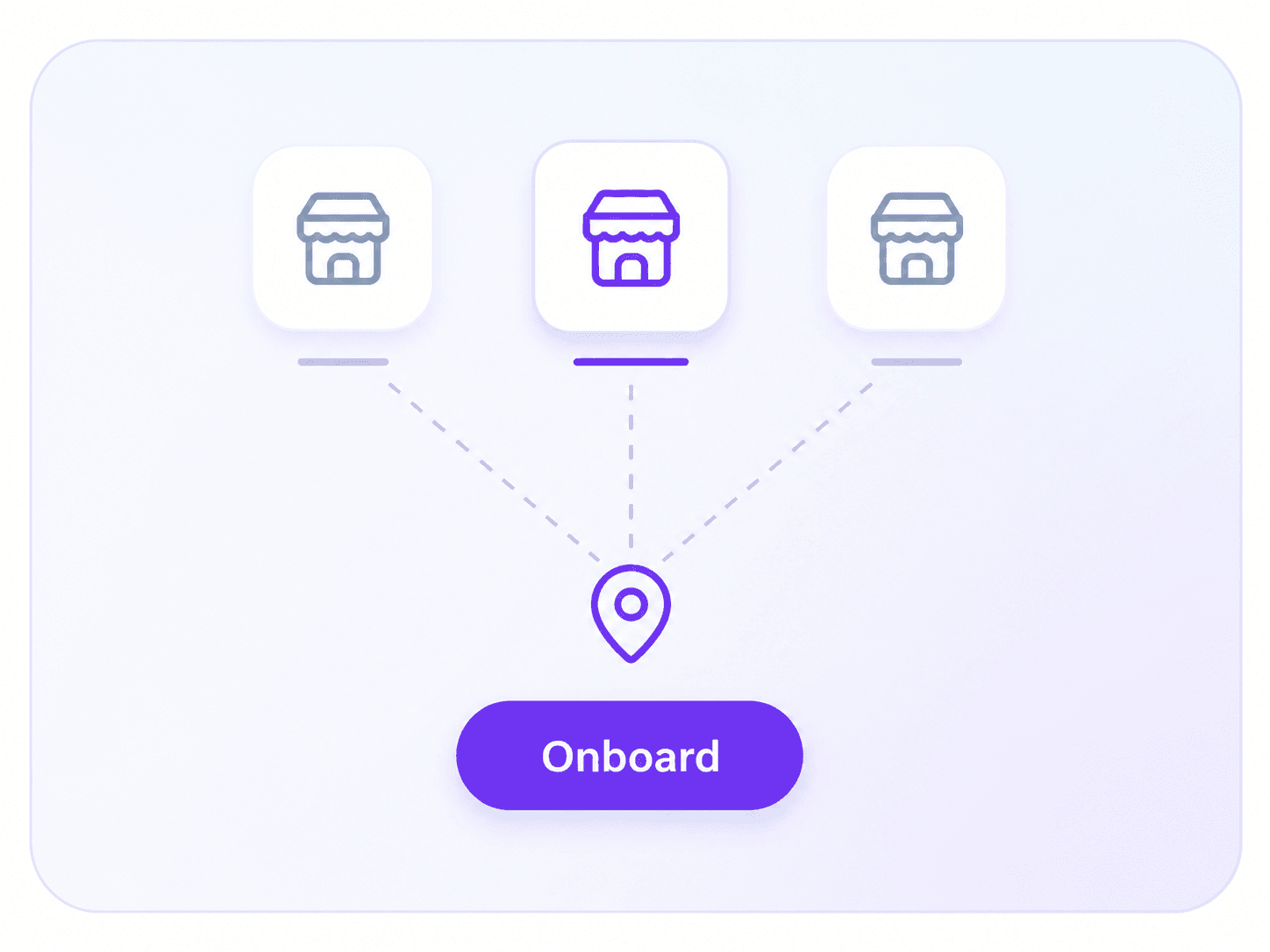
The next step is onboarding 5 to 8 retailers within a single Brisbane catchment to test operations, listings, discovery and participation together.

The pilot is designed to validate publishing behaviour, discovery, poll participation, redemptions and repeat engagement.

Insights from the pilot shape product refinement, onboarding, marketplace operations and the next growth phase.
Capability status
Reward's Mate store discovery and profiles
PrototypeProduct catalogues and sale listings
PrototypeSeasonal product polls and voting
PrototypeDigital card and reward states
PrototypeShopper's Mate POS and retailer dashboard
In buildRetailer listing and poll publishing workflow
Planned for pilotShared production backend and real-time publishing
PlannedMarketplace analytics and ranking
Future, data-dependentReward's Mate prototypes
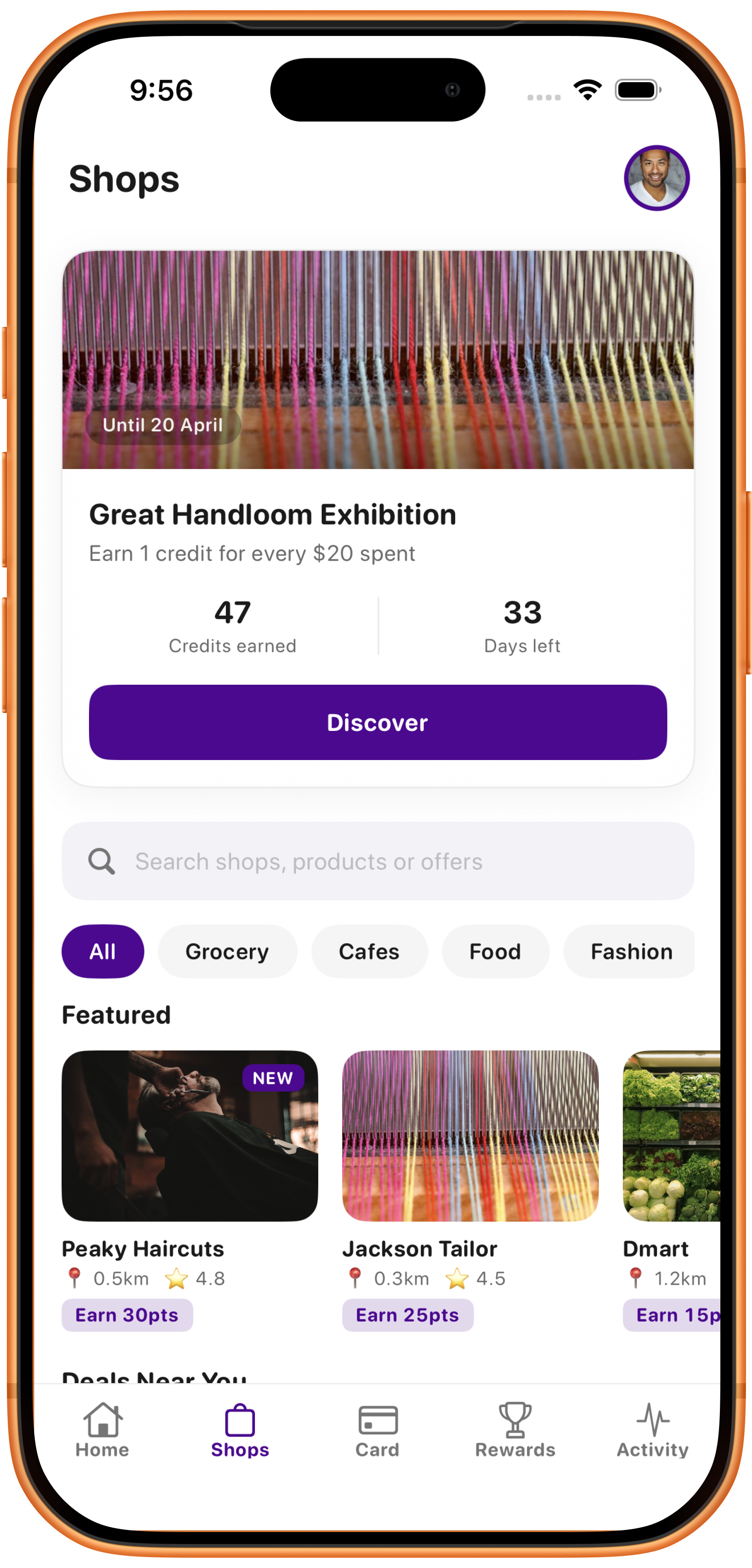
Store discovery, sale listings, digital card and community polls currently exist as product prototypes, not live production infrastructure. They show how Reward's Mate can turn participating retailers into a local network customers return to.
Next milestone
Density within one catchment is more valuable than a scattered store count because nearby participating retailers can create a more useful customer network, clearer cross-retailer discovery behaviour and stronger local feedback loops.
Measure retailer publishing, customer discovery, poll participation, QR activity, redemptions and repeat engagement.
Shopper's Mate will move from prototype and MVP foundations into a connected retailer pilot, then expand marketplace operations, intelligence and monetisation only as validation supports each step.
Now
POS checkout, product catalogue, QR loyalty, retailer dashboard and Reward's Mate discovery, sale-product and community-poll prototypes.
Next
Real retailer profiles, managed listings, limited poll creation and measurable engagement in a concentrated local cluster.
Phase 2
Self-service publishing, moderation, templates and freshness controls after pilot learning.
Phase 3
Turn transaction, loyalty, listing, campaign and polling signals into practical recommendations as data matures.
Future
Expand publishing, marketplace placement options and broader Australian coverage after validation.
Roadmap discipline
Timing remains subject to pilot learnings, retailer feedback, funding, and measured ROI. Shopper's Mate should only scale each phase after the prior phase proves retailer value.
Investor takeaway
The major execution risks are known and listed in full below. The pilot is designed to test them early.
Risk: Independent retailers may resist paying for a growth bundle when cheaper POS tools exist.
Mitigation: Lead with clear published pricing ($350 per store, per month plus 1.25% of net eligible sales excluding GST), measure repeat engagement and campaign value, then convert retailers only after value is demonstrated.
Risk: If loyalty slows down checkout, staff and customers may avoid it.
Mitigation: Keep QR scan fast, make rewards optional during checkout, and prioritise speed over feature complexity.
Risk: Early retailers may not have enough data for advanced AI recommendations.
Mitigation: Start with rule-based insights, simple segmentation, campaign reporting, and directional analytics before advanced models.
Risk: Retailer setup can become slow if product import, device setup, or staff training is manual.
Mitigation: Use manual onboarding during pilot, then standardise templates, imports, and support workflows before scaling.
Risk: The customer app must provide enough value for shoppers to scan and return.
Mitigation: Focus on simple points, visible rewards, digital receipts, nearby discovery, offers and community participation.
Risk: Building complex AI, payments or marketplace monetisation too early could slow MVP delivery.
Mitigation: Pilot listings and polls before introducing ranking, payments or complex marketplace monetisation.
Risk: A thin marketplace with too few retailers or listings will not give customers a reason to return.
Mitigation: Launch in a concentrated retailer cluster rather than spreading the pilot across unrelated areas.
Risk: Out-of-date products, prices or expiry details can reduce trust quickly.
Mitigation: Use clear start and expiry controls, retailer verification and managed onboarding.
Risk: Busy store teams may not keep listings and polls fresh without support.
Mitigation: Reuse catalogue data, provide templates and guide the first campaigns manually.
Risk: Votes can signal interest without guaranteeing later sales.
Mitigation: Show sample sizes, treat votes as directional and compare results with actual sales where possible.
Risk: Repeated or low-quality votes could distort demand signals.
Mitigation: Use account-level controls and basic abuse monitoring when the real backend is implemented.
Risk: Customers may browse listings without converting into in-store visits or redemptions.
Mitigation: Compare marketplace engagement with QR scans, redemptions and repeat activity where measurement is available.
Risk: Customers may hesitate if data use feels unclear or extractive.
Mitigation: Use visible consent controls, aggregate reporting and do not present identifiable customer data as a product for sale.
This section is not yet complete. The founder will confirm the raise details before this page is published.
Shopper's Mate comes from first-hand experience in retail execution, inventory operations, customer service, and data analytics.
Shopper's Mate started on the shop floor, not in a pitch deck.
Before building Shopper's Mate, I worked inside retail operations at Woolworths Metro, where I saw how much decision-making happens every day around stock, promotions, gaps, ordering, customer demand, and store execution.
The part that stayed with me was simple: store teams already carry a huge amount of operational knowledge, but most systems only help record what happened. They rarely help turn that knowledge into better customer loyalty, smarter offers, stock decisions, or repeat revenue.
Working in retail also showed me how often promotional and short-run product decisions are made with incomplete local demand signals. Store teams know their customers, but most systems do not give them a direct way to ask what shoppers want, test interest and connect that response with campaign or sales outcomes. Shopper's Mate and Reward's Mate are being built to close that gap.
With my background in data analytics, machine learning, and retail operations, the gap became obvious. Large chains have tools to connect transactions, customer behaviour, inventory, and campaigns. Independent retailers often face the same problems, but without access to the same level of insight.
Shopper's Mate is being built to connect store operations, Reward's Mate loyalty, local product discovery, community demand signals and practical retail intelligence in one platform for independent retailers.
Retail operations
Worked inside day-to-day store execution, inventory workflows, stock availability, and promotion activity.
Data analytics
Trained in computational data science, analytics, and machine learning.
Customer behaviour
Saw how checkout and loyalty data could become much more useful for retailers.
Founder insight
Independent retailers deserve access to the kind of decision-support tools large chains already use.
I did not start Shopper's Mate because I wanted to build another till. I started it because I saw how much valuable retail knowledge is created every day inside stores, and how little of it turns into customer loyalty, campaign decisions, or stock intelligence.
We are building Shopper's Mate with a focused pilot-first approach and are open to conversations with investors, advisors, retail operators and early partners who understand the future of local retail technology.
Detailed commercial assumptions and financial plans are shared for investor discussion and remain subject to pilot validation.